
The Masterful Making of Lynchburg at War
By: Emily Mook | Photos By: Ashlee Glen
“Teamwork gives you the best opportunity to turn vision into reality.” – John C. Maxwell

As singular concepts, creativity and collaboration undoubtedly drive change.
A painter with a brush, a writer with a pen, a musician with an instrument—these and other solo creative pursuits account for much of the world’s great art and prove that individual perspectives and pursuits can change history. Non-creative acts of collaboration also make significant impacts by creating reliable systems, maintaining structures, and improving processes that are integral to modern human existence. The novelty of creativity and the consistency of non-creative collaboration both play important roles in shaping the world around us and in shaping our own understanding of ourselves and the roles we play as individuals and as members of a collective.
Then there is the magical and somewhat elusive point at which these notions converge and creative collaboration is born. When you consider your favorite bands, films, and other joint ventures that entail the intentional sharing of creative control and presence of multiple perspectives within a single project or process, you likely experience a feeling of serendipity. The best creative collaborations can make you think, “Those people were meant to make art together.” Within minutes of sitting down to interview Greg Starbuck, Lindsey Smith, and Daniel Dixon, I was struck by that very conviction.
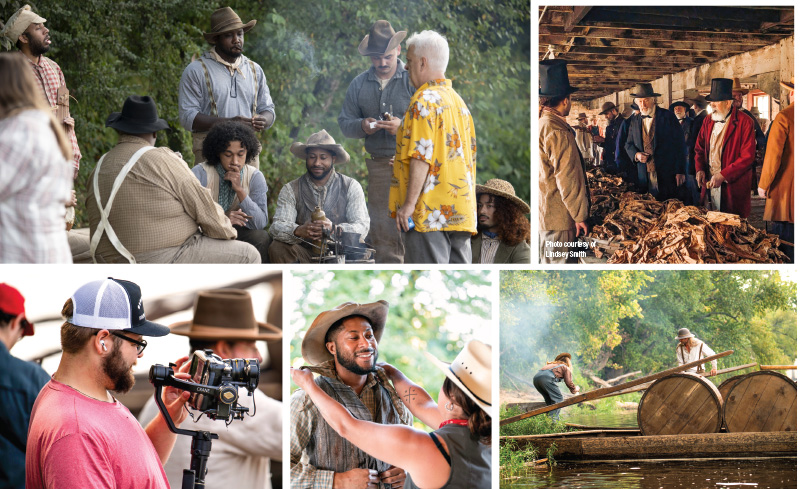
Starbuck, Smith, and Dixon are the three main collaborators on Lynchburg at War, a locally produced and filmed documentary that delves into the everyday experiences of distinct groups of people living—or stationed—in Lynchburg during the Civil War.
Starbuck, who has been the executive director of Historic Sandusky since 2002, is the documentary’s writer and director, Smith is its wardrobe supervisor, and Dixon is its production and set designer—but these titles barely scratch the surface when it comes to what the three have poured into the film.
“There’s not really a name for what we do,” Dixon noted. “If there’s a need to be fulfilled, we find a way to get it fulfilled. If there’s cohesiveness that’s needed, that’s what we handle. Every mile, every step of the way, the three of us are lockstep. We tend to be the triumvirate. ”
Lynchburg at War first came about after Starbuck’s 2010 film Hunter’s Raid: The Battle for Lynchburg wrapped.
“We had so much fun working on that film that as soon as it wrapped, we said, ‘Well, let’s do another one!’” Starbuck said. “We worked on it for a couple of years, set it aside, and then I started working on it again in 2016. Then a bunch of forces came together within the past year, and we thought, ‘You know, it’s time to go ahead and finish this.’”
Dixon and Starbuck, who met when Dixon’s construction company built some additions and did some renovations for Historic Sandusky when the organization was first getting its legs, worked on Hunter’s Raid together and discovered a shared propensity for pulling out all the stops.
“We are ‘more cowbell’ type people,” remarked Dixon. “Our director of photography, Rob Hodge, came to town one day. Greg had initially asked me if we could find a van that had a door in the side that we could shoot from the inside out to emulate a train car.
Well, instead of doing that, we ended up building a bunch of train cars! We built one, decided that wasn’t enough, built another, still needed more cowbell, built another, and so on. We like to max out to the extent that we can line up resources and find contributors who we know will fulfill their commitments. Doing things this way provides a real sense of enjoyment and a real sense of accomplishment.”
That level of dedication typifies Lynchburg at War to an even greater degree with the addition of Smith to the crew.
“Her qualities are endless,” Dixon said of Smith. “I knew she had a background in art, dance, and history. I asked her if she would be interested in getting involved in this project and she enthusiastically goes, ‘Oh yeah!’”
“And the next thing I know, I’m making 2,000 tobacco leaves!” Smith exclaimed with a laugh.
Those tobacco leaves, constructed from brown paper and then meticulously colorized, are just one of the myriad aspects of the film imbued with a reverent commitment to authenticity. The driving force behind this reverence is Starbuck’s extensive knowledge—bolstered by decades of research—of Lynchburg during the Civil War.
“I have collected so many primary and secondary sources and even did my master’s thesis paper on Lynchburg during the Civil War,” he stated. “The primary sources that really inform this documentary are people’s diary entries and letters. We’re trying to make the documentary really speak from their words and take ourselves out of the equation. One of the common problems of history is people interpreting it for their own purposes. We want to bring the original voices out to the forefront.”
Among those voices are those of African Americans, most of whom were enslaved and many of whom worked in tobacco warehouses and operated batteaux to transport tobacco hogsheads and other supplies during this period of Lynchburg’s history.
“The perspectives of African Americans are often lost because many of them did not write, and they were often mentioned as an afterthought in journals and letters,” remarked Starbuck. “Faithfully presenting their side of the story is a challenge, but it is critical to this presentation.”
The stories of women—especially those who assisted with war efforts—during this period are also largely underrepresented in film.
“These are untold stories,” said Smith.
“A lot of what we’re shooting has never been shot before. Anyone who has done any sort of genealogy knows that there are huge gaps in the information we have about our history. The stories that we’re telling—the Gunpowder Girls, the Ladies’ Relief Hospital, the batteaux scene—if we don’t tell their stories, who’s going to tell them?”
In addition to authentic and authentic-looking props—some owned or made by cast and crew members and others provided by Buzzards Roost antique shop owner Todd Hunley—telling these stories faithfully requires meticulously designed sets, period-accurate costuming, and dedicated actors.
“When it comes to production and set design, we don’t build from the ground up; rather, we look at how many possibilities are available to us,” Dixon noted. “You also have to shoot around so many things. Some of the places we use are very familiar to people and they would recognize them right away; for instance, we did a shoot in front of the chapel at the Quaker Memorial Presbyterian Church. So we say, ‘These are some possible places we could go; now who do we know there and how do we get access?’ We try to take each space and material we have access to and milk it like a sponge. For example, when we shot the Ladies’ Relief Hospital, we took apart all the platforms that we had used for the tobacco auction shoot and reassembled that sawmill lumber into tables, walls, and doorways.”
As far as costuming goes, LionHeart FilmWorks founder and costume designer (among several other titles) Kevin Hershberger has lent most of the film’s costumes.
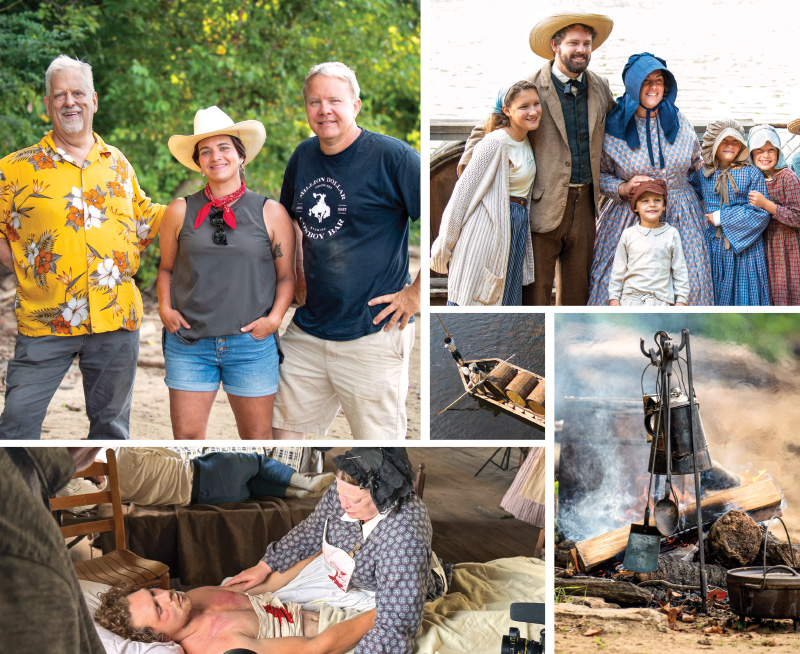
His Richmond-based costume house is the largest historical costume house in the U.S. outside of Los Angeles and New York City.
“Usually, we’ll go to Richmond and pick out what we need for the upcoming shoot,” remarked Smith. “In costuming, we have to think about what the actions are going to be. Are these going to be women who are coming in from outside? Are they going to need a parasol or a fan? Are they going to take off a bonnet and hang it up? I love creating individual stories within the overall story.”
Of course, aesthetic authenticity is only half the battle when it comes to making a war documentary of such a high caliber; the actors must also imbue their roles with emotional heft and nuance.
In addition to staged scenes that have literally required the actors to get into character—for instance, the women in the Gunpowder Girls segment of the film actually assembled cartridges for a few hours—some serendipitous moments of impromptu collaboration have allowed the actors to more fully embody their roles.
“I don’t even know if this is a conscious decision, but what we do impromptu on micro and macro levels is we plan things out to a point,” Starbuck stated. “We get all the people together, and the people generally have an amazing amount of talent and creativity themselves. We put all the elements in place, and then we end up brainstorming on the spot. It just happens organically.”
A balance between fun and focus amongst the cast and crew—composed of a mix of professionals and amateurs—provides the ideal environment in which these unplanned moments can unfold.
“While we do have a great time on set, we understand that at the end of the day, we have a responsibility to tell these stories respectfully and accurately,” said Dixon.
This strong sense of community on set in some ways mirrors Lynchburg’s overarching experience after the Civil War.
“Lynchburg’s story is unique because it was really the only city in Virginia that wasn’t captured and then destroyed,” noted Starbuck. “Lynchburg’s recovery from the war in terms of economy, commerce, and race relations was probably better than any other city’s recovery in the South. There were Northern investors down here within weeks, stores were filled with goods, farms were not destroyed, and there was still some livestock here. Lynchburg resumed normal business pretty quickly, which goes against type. Lynchburg is a different story—a story of resilience, luck, and focus. We have a different story to tell.”
With filming still underway, that story is still unfolding. Starbucks hopes for a spring 2026 premiere and notes that the film will be released on Blu-ray.
As he sat back in his chair and beamed at his two closest and most trusted compatriots in this venture—this magical meeting place of creativity and collaboration—Starbuck voiced his own wonder at the magnitude of it all.
“Seeing what started as an idea in my head grow beyond my expectations has been so rewarding, as has seeing the fulfillment and joy on people’s faces both behind the scenes and in front of the camera,” he said. “We’re all dreamers. It’s hard sometimes in life to participate in something bigger than yourself and put your stamp on it. When you can give someone the opportunity to rise above the daily mundane and explore their dreams, you do it.”