

How to strike the balance between styled layers and lived-in comfort—without tipping into chaos here’s a fine line between a home that feels thoughtfully layered and one that feels…busy.
We’ve all walked into both. One feels collected over time, rich with story and texture. The other feels like every surface was filled simply because it could be. The difference isn’t necessarily how much is in the room—it’s how intentionally it’s arranged.
If you love books stacked on side tables, ceramics collected from travels, framed photos, woven baskets, vintage finds, and a healthy mix of new and old, but you worry about crossing into clutter, this guide is for you.

Here’s how to create a home that feels curated, not crowded.
Start with Breathing Room
Before adding anything, step back.
Every well-styled space begins with negative space—the empty areas that allow your eye to rest. Think of it as visual oxygen. Without it, even beautiful objects begin to compete.
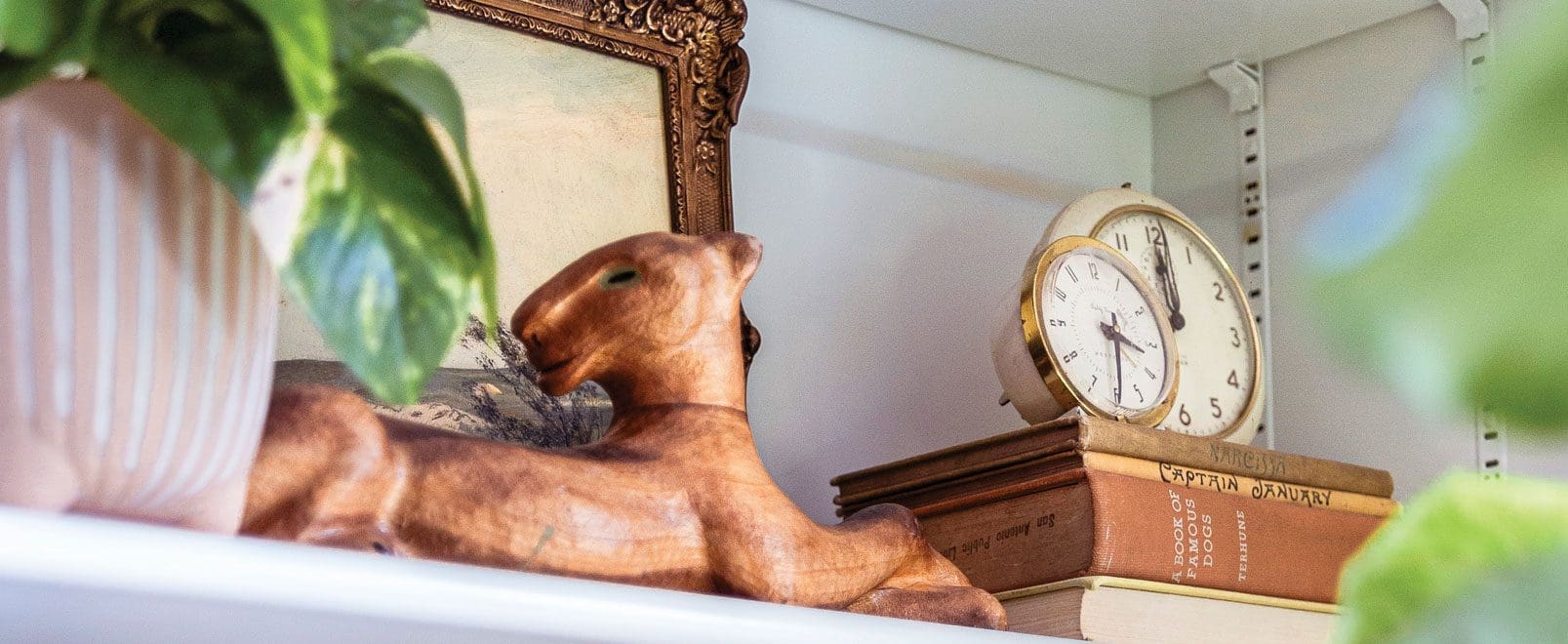
As a general rule: not every wall needs art, not every shelf needs to be filled, and not every tabletop needs décor. If you’re styling built-ins, leave a few shelves partially empty. If you’re working with a gallery wall, allow for consistent spacing between frames.
Editing is often more powerful than adding.
©PHOTO BY DARYL CALFEE
Create Visual Anchors
Clutter often happens when a room lacks a focal point. When everything is competing for attention, nothing stands out.
Choose one or two anchor elements per room:
• A statement light fixture
• A large piece of art
• A bold rug
• A beautifully styled mantel
• A sculptural chair
Once your anchor is established, let the surrounding décor support it rather than rival it. Smaller objects should feel like supporting characters, not co-stars.
Think in Layers, Not Piles
Layering creates depth; piling creates chaos.
The difference? Intention and variation.
Instead of lining up objects of similar height and size, vary scale and shape.
Pair something tall with something low. Combine smooth ceramics with woven textures. Place art behind a lamp or slightly overlap framed pieces on a shelf.
A simple formula to try on coffee tables
or consoles:
1. Something vertical (a vase, candlestick,
or lamp)
2. Something organic (greenery, a bowl of fruit, a branch)
3. Something personal (a book, photo, or collected object)
Three elements often feel balanced without feeling busy.

©PHOTO BY DARYL CALFEE
Corral the Small Stuff
Small objects are usually what push a room from curated to cluttered.
The fix? Containment.
Use trays, bowls, baskets, or decorative boxes to group smaller items. Instead of five separate candles scattered across a surface, place two or three on a tray. Instead of loose mail on the counter, use a woven basket. Instead of remotes floating on a coffee table, use a lidded box.
When small items are visually grouped, they read as a single design moment rather than visual noise.
Stick to a Cohesive Color Story
Even eclectic homes benefit from a defined palette.
This doesn’t mean everything must match. But choosing a general color direction—warm neutrals, moody jewel tones, soft coastal hues—helps diverse pieces feel connected.
If you’re unsure, look at what you already own. What colors repeat? What tones do you naturally gravitate toward?
Then, when adding something new, ask: Does this complement what’s already here?
When color feels cohesive, layering feels intentional.
Mix Eras—But With Restraint
A home filled entirely with brand-new pieces can feel flat. A home filled entirely with vintage can feel heavy. The magic is in the mix.
Pair an antique wooden chest with a modern lamp. Style heirloom china inside streamlined cabinetry. Hang contemporary art above a traditional console.
The key is balance. If everything is ornate, it becomes overwhelming. If everything is minimal, it lacks warmth. Let contrasting elements enhance one another.
Leave Room for Function
Sometimes what feels like clutter is simply poor function.
Decor should never interfere with daily life. If you’re constantly moving objects to use a surface, that surface is over-styled.
Coffee tables should still hold coffee. Nightstands should still hold a book and a glass of water. Kitchen counters should allow space for meal prep.
When décor supports the way you live—rather than complicates it—your home feels calmer instantly.
Rotate, Don’t Accumulate
You don’t have to display everything at once.
One of the simplest tricks professional stylists use is rotation. Store seasonal pieces or extra décor in labeled bins and swap them throughout the year.
Shelves feel refreshed, and you avoid the slow build-up of excess.
This also allows sentimental objects to shine when they’re displayed—rather than disappearing into visual overload.
Make It Personal (But Edit Thoughtfully)
A curated home tells a story.
Photographs, children’s art, travel souvenirs, inherited pieces—these are the elements that make a house yours. The goal isn’t to remove personality in the name of minimalism. It’s to showcase it well.
Choose your favorite pieces. Frame the art instead of taping it to the fridge.
Give that inherited bowl a place of honor rather than tucking it behind other items. Display collections together instead of scattering them throughout the house.
When personal items are presented intentionally, they feel meaningful—not messy.
Do the “Squint Test”
When you feel unsure, try this: stand in the doorway and squint.
What do you notice first? Does your eye know where to land? Or does it bounce around the room?
If everything feels loud, remove one or two things and reassess. Often, subtracting just 10 percent of a room’s décor dramatically shifts how it feels.
Remember: Curated Doesn’t Mean Perfect
The most beautiful homes aren’t museum displays. They feel lived in.
Books are dog-eared. Throws are slightly rumpled. A stack of mail sits on the desk—contained, but present.
Striking the balance between styled and sincere takes practice. It requires stepping back, editing bravely, and choosing pieces that truly resonate rather than simply fill space.
A curated home isn’t about having less. It’s about choosing well.
And when each object has room to breathe, your home doesn’t just look better—it feels better.


