

Exploring Real, Tangible Art in an Age of Algorithms
By: Charlotte Farley | Photos By: Ashlee Glen
I don’t know about you, but I’ve been craving a return to a more analog kind of life, gravitating toward something that I can touch and hear without needing screens and Internet service. For my birthday, my husband gave me a stereo system complete with a turntable and CD player. When I finally listened to music through those killer speakers after years of streaming on Pandora or Spotify, the sound startled me in the best way possible. It was rich. It was bold. It was beautiful. That small shift back to analog made me feel what I’d been missing, which is exactly the energy behind the Maier Museum’s new exhibition Audacity: The 114th Annual Exhibition of Contemporary American Painting.

For more than a century, this annual exhibition has showcased contemporary American art in all its shifts and reinventions, and this year’s focus on painting feels both timely and strikingly fresh. This show is indeed a vivid display of what it means to have the audacity to create something purely from one’s own hands, with one’s own imagination and heart. In other words, how dare we be human.
The History of Maier Museum’s Annual Art Exhibition
The Maier’s annual exhibition series began in 1911, when Randolph-Macon Woman’s College committed to bringing the strongest contemporary American art to its students each year. For decades, that meant painting. The show functioned as a cultural gateway that introduced both the college community and Lynchburg at large to the best work emerging in the medium.
For the first half-century, the annual exhibition centered almost entirely on painting, but in the decades since, it has expanded to reflect the growing range of media explored by contemporary American artists. This year marks the first time in nearly thirty years that the exhibit returns to painting alone, echoing its earliest roots.
“It felt like time to revisit painting,” said Martha Johnson, director of the Maier Museum.

The Spirit Behind the Art Exhibition
Johnson explained that the spirit behind Audacity grows out of the moment we’re living in. Conversations about AI—its speed, its opacity, its uncanny output—have become impossible to ignore, and so much of the imagery we encounter now is generated instantly by software. In that landscape, returning to painting feels purposeful.
“We’re all feeling some uncertainty about where AI is going—or has already gone,” she said. “It isn’t something that’s ‘coming’; it’s blown past us, and that can feel very untethering.”
For Johnson, this exhibition is “a kind of answer to what’s happening. It’s a reaffirmation, a fearless reaffirmation, of the medium of painting.” And even as the show responds to all that technological drift, she hopes its effect is simple and human. “I want visitors to be delighted.”
Meet the Artists Behind Audacity: The 114th Annual Exhibition of Contemporary American Painting
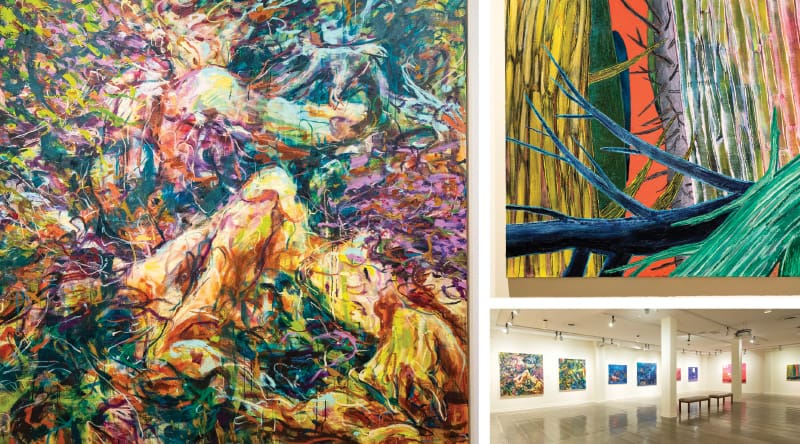
The exhibition brings together four large-scale painters (Sally Egbert, Julia Jo, Sue McNally, and Walter Price) whose canvases radiate gesture and presence, inviting visitors into the physical presence of work shaped directly by human hands. Each selection embraces that physicality. One navigates gigantic, state-by-state landscapes after time spent outdoors. Another literally tosses paint onto canvas.
“Whether you’re using a brush, tossing paint like softballs, or pouring it the way Sally [Egbert] does,” Martha said, “there’s such physical pleasure in the act itself. What painting is, for all of these artists, is the pure joy of painting—the tactility, the sensuousness, the sheer joy of a pure color.”
The Experience of Maier Museum
The Maier Museum is intentionally welcoming. Admission is always free and there are various community programs, talks, and even camps for kids and other programs for high school students. Johnson wants a visit to the Maier to feel as normal as a stop at the library or a walk in the park.
“The default for a lot of people is thinking they don’t know enough to come here, or that it’s going to be expensive,” she said. “There’s no test at the end. We’re not trying to stump anyone. We just want people to come in and spend time with the art.”
Staff members aim to offer visitors a “hook”—just enough context about process or history to spark curiosity—without flattening a painting into a lecture.
For many regulars, the museum’s permanent collection has become something of a community of familiar faces. Visitors return to particular works like old friends within the richly colored galleries.
Maier Museum’s Hours and Exhibition Details
Above all, this exhibition extends an invitation: slow down, step close, and let color work on you. As Johnson puts it, “I would love for people to have had a joyful experience—to feel that painting is still a vital force—and to have set their anxieties aside for a moment and get lost in the art.”
Audacity reminds us that standing in front of paintings can be as surprising and alive as hearing music on real speakers again. It turns up the volume on what it means to be human. And painting, it turns out, still has plenty left to say.
ON VIEW:
October 19, 2025 – March 8, 2026
More Information: maiermuseum.org
Hours: Wed–Sun, 1–5 p.m.
RELATED CONTENT:
The Cold War History of the Maier Museum
Inside the Lynchburg Art Club and Gallery


