

Nestled just outside of Lynchburg’s urban sprawl in Concord, a 22-acre farm offers sanctuary and second chances for farm animals in need of a home.
By: Shannon Kelly / Photos By: Makers Workshop
When Kimberly Clark moved to the Lynchburg area from West Virginia in 2011, she rented the farm property so her horse and miniature horse could have a home with her. Looking at the barn, Clark said she knew she wanted to fill it. The farm family quickly expanded to include two special-needs goats who had nowhere else to go, then a blind cow. Thus, the mission and reputation of a farm animal sanctuary sprouted.

“Before I knew it, I kind of had a barn full of special-needs critters,” she said.
Clark’s love for animals was innate; she grew up around them.
“My maternal aunt had horses always, and my paternal aunt lived on a ranch, so it was something I grew up with,” she said. “I think I probably rode a horse before I could walk.”
When the landlord eventually informed her the property would be sold, Clark offered to buy it. \
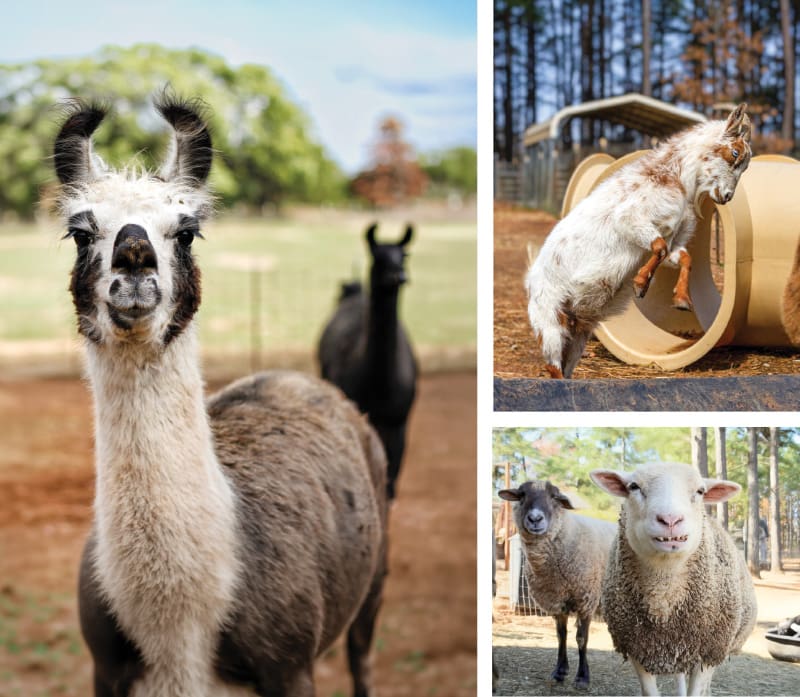
Officially, Virginia Farm Animal Sanctuary was founded as a nonprofit in 2025, but the mission had really been operating for more than a decade prior. What started with two special-needs goats turned into a farm of diverse mammals and barnfowl.
After the first special-needs animals came in, a little baby donkey set Clark in a new direction.
At 4 or 5 weeks old, the donkey was undernourished when Clark found him.
“He was kind of all rolled in a little ball, tucked up, and he had really long hair,” she said. “I sat down next to him, and he got down, and he curled up in my lap and threw his head over my shoulder, and that was it.”
There was not much public information on bottle-feeding baby donkeys at the time, Clark said, but an organization called Peaceful Valley Donkey Rescue kept coming up in her searches. When she reached out to the organization, they responded within hours and helped support her education in donkey care.
With the intake of donkeys came awareness of the global donkey hide trade. The situation spurred Clark into more focused action, and in 2014, VFAS became an adoption center helping place rescued donkeys into forever homes. By the time 10 rescue donkeys came to land with Clark and her team, and as calls steadily continued coming in, Clark founded Virginia Donkey Rescue, creating a dedicated donkey rescue and rehoming program in the commonwealth.
VFAS is a sanctuary, Clark explained—not a rescue. And there are more than just donkeys there.
The donkeys often came with companion animals, from barn cats, to goats and sheep, to dogs, ducks, llamas, and other barn fowl, Clark said. VFAS encompassed the inclusivity and scope of work. Fifteen years after her move to Virginia and propulsion into mission, Clark leads VFAS, and provides a home to more than 200 animals—about half of them goats, donkeys, and pigs, and the other half various types of barnyard birds.
At VFAS, Clark said the focus is on animals’ present and future, not their pasts.
“We don’t focus on their past,” she said. “It’s just…that would kill you as a rescuer, and I think it kills a lot of rescuers. I think they burn out on the whole thing, because they do focus on all the bad parts, and I just prefer to focus on their present, and their future.”
Most of Clark’s current animals came from owner surrenders, and she has focused on taking in older or sick animals who would not have a good chance of being successfully rehomed. They get to live out the remainder of their lives in sanctuary, cared for by Clark and her team of dedicated volunteers.
Clark wants others to view the sanctuary as something like an extension of the local humane society.
“They can’t take a pig, or a donkey, or a goat, but we can,” she said.
A typical day on the farm starts early with a walk-around of the property, checking on animals’ health, monitoring enclosures, and the like. Breakfast is next, a more time-consuming activity given the large herd. After morning feed, Clark said there are a couple of hours for “special projects”: cleaning stalls, trimming hooves as needed, knocking down cobwebs, and other tasks. Volunteers groom donkeys and otherwise spend time loving on the animals, providing them enrichment. Then, the time comes to prepare for evening feed.
Clark goes to bed exhausted physically but satisfied mentally.
“There’s that saying that when you find your passion, it doesn’t feel like work,”
Clark said. “Once I met my baby donkey, none of what I’ve done for the animals has ever felt like work. So, I go to bed tired in an exhausted kind of way, but not in a mentally exhausted kind of way.”
Over the years, Clark has also developed a different perspective on owner surrenders.
“One thing that this life has done for me is, I used to be very judgmental of people that surrendered animals, and I was young and foolish thinking this, but I was like, ‘If you’re going to make that commitment to them, you need to make that commitment for life,’” Clark said. “But what picking up all these donkeys and other animals throughout the years now has taught me is that, life can blow you some really significant blows, and it’s most often out of your control, so the best thing I can do is not be judgmental about the people, and be helpful, especially with the older, sick animals that would be almost impossible to place elsewhere.”
Some owners who had to give up their animals due to various circumstances still come visit the farm, or even volunteer there, Clark added. In other cases, she has been able to help owners keep their animals by providing various kinds of support.

Bonnie Swanson, a volunteer at the sanctuary, has experienced nearly every aspect of the stories these animals come with: Swanson had to surrender some animals when life threw new circumstances at her. Then she became a volunteer at the same sanctuary where her donkeys came to live, and she is also a regular donor to the organization.
Swanson owned and operated a tourism farm for many years, but about two years ago, as she settled further into retirement, the time came to downsize and slow down. Then came the difficult decision: Swanson had to find a new home for the three donkeys she’d had for about 15 years, as well as two goats.
“That was a difficult time,” she said. “I tried to find homes for them with people that I knew and then saw Kimberly again, and she said, ‘Oh, we’ll take your donkeys!’”
Swanson never saw herself leaving her farm, or parting with the animals she’d loved for so long.
“Life changes,” Swanson said. “I always felt that we’d be at the farm till we’re no longer on this earth, and then I’d will the donkeys to my children. I always threatened them with that. But, you know, life changes, and we decided we were just going to go to a smaller piece of property. It’s an acre, and in a neighborhood, to boot.”
Swanson knew Clark from a time they did fundraising work together after being introduced through a mutual friend, and with this personal foundation, Swanson was relieved to place her animals where she knew they would be cared for—and where she could still spend time with them. She described working with animals at the sanctuary as a symbiotic relationship, and a respite. Plus, it provides a chance to disconnect and reconnect: to put down the phone and enjoy the company of other volunteers as well as the animals.
Clark seeks more volunteers to help support VFAS and its mission. The roles that need filling are not just picking up manure, she said; for example, Clark could use help maintaining the farm’s website, a job that would not even require someone to be on-site.
Volunteers who could focus on fundraising efforts are also needed, Clark added.
This summer, a capital campaign is ongoing, focused on raising $199,000 to fully pay off the property, solidifying it as fully owned by Clark, and VFAS, providing a greater level of security for the animals who call it home.


